



North Shore Morning
- Monday 8-10am
- Tuesday 8-10am
- Wednesday 8-10am
- Thursday 8-10am
- Friday 8-10am
News and information, interviews, weather, upcoming events, music, school news, and many special features. North Shore Morning includes our popular trivia question - Pop Quiz! The North Shore Morning program is the place to connect with the people, culture and events of our region!
North Woods Naturalist: Bobcats
-There's been an increase in reports of bobcats along the North Shore recently. WTIP's CJ Heithoff checks in with Chel Anderson to find out more about the feline animal in this edition of North Woods Naturalist.
Wildersmith on the Gunflint - January 25, 2019
-Wildersmith on the Gunflint by Fred Smith January 25, 2019
Last weeks’ report had barely hit the airwaves when my mention of the usual north woods January cold spell being AWOL surrendered to a big turn-around. Folks living in the territory know of what I’m talking, while others in WTIP range, who may be wondering what it’s like on the Gunflint, can be assured it has been seriously cold.
How cold was it? Temps have remained below zero here in border country for most days since a week ago today (Friday). While temperatures vary considerably from place to place, at Wildersmith, thirty below zero and lower was common for a number of mornings with a brisk minus 40 recorded last Sunday morning.
These are actual thermometer readings, not the hokey wind chill sensationalism from the weather media. If one lives out this way, you don’t have to be told its dangerously cold when even the slightest the wind is blowing as such is done in Urbania for oblivious younger generations
Needless to say, outdoor activities around here have been curtailed except for critter feeding time, runs to the mailbox and many trips to the woodshed. The Smith’s have just hunkered down and enjoyed the warmth around a crackling wood burner. The romance of cozying up on a still, bitterly cold night in the north woods can’t be matched, especially when one doesn’t have to get out in the morning for a trek to work.
Meanwhile, miracles of life below zero go on un-interrupted amongst our “wild neighborhood” critters. How those pert little chickadees and nuthatches survive is incredible. And as if frost on the windows wasn’t enough evidence of bitter cold, jay birds and pine grosbeaks were fluffed up like puff balls as they wait for time at the feed tray. While pine martens and squirrels, with frosted whiskers and nary a shiver, seem undaunted in their daily morsel search.
During our last trip to the Village, we came upon a moose trio in the middle of the Trail near Little Iron Lake. It was a momma and her twin adolescents. Getting to see them in multiples is always a treat.
They were blocking traffic, of course, so we slowed to a stop. Momma readily departed into the ditch. However, it was a different story for her kids as they struggled to remain upright on the icy surface. After some slip-sliding about, the gawky juveniles made it to the safety of the snowy roadside and disappeared into the forest.
Visiting with a friend a few hours later, it was disclosed she came upon a trio in the same location just moments after we had passed. Guess the salt on the road must have been a tasty attraction in that locale and lured them back onto the ice-covered blacktop.
The storied John Beargrease Sled Dog Marathon heads north from Duluth to Grand Portage, starting on Sunday. While the 2019 course has been shortened to three hundred miles, it will nevertheless be heading up the Gunflint Trail to Trail Center Monday, with early leaders expected around 10:00 am. After a mandatory layover, all should be departed by around 10:00 in the evening on their way to the Grand Portage finish.
The best means of catching a glimpse of the mushers as they come up this way would be to check the Beargrease website or to be in the mid-trail area during the day. Of course, there will be plenty of canine energy, excitement and color as usual out here, and at Grand Portage, which is not that far away. Come on out and give these teams a Gunflint Community welcome.
For WTIP, this is Wildersmith on the Gunflint Trail, where life below zero is great, even though a bit unforgiving for the faint of heart!
Sawtooth Mountain Elementary - School News January 24, 2019
-Sawtooth Mountain Elementary - School News with Adam and Lute.
January 24, 2019

In the Spirit of Medicine - Dr. Arne Vainio
-In the Spirit of Medicine
"What's in a Name"
Dr. Arne Vainio is an enrolled member of the Mille Lacs Band of Ojibwe and a family practice doctor on the Fond Du Lac reservation in Cloquet. His essays on life, work, medicine and spirit are published in "News From Indian Country”.
Birch Grove Elementary - School News - January 23, 2019
-Birch Grove Elementary School News with Niranjan, Nataliya and Dayne.
January 23, 2019
North Woods Naturalist: Deer in winter
-White-tailed deer can be found across almost all of North America, and our area is no exception. However, the North Shore climate creates some unique challenges for deer, particularly in the winter.
WTIP's CJ Heithoff talks with naturalist Chel Anderson about how deer manage the snow and other wintry conditions in this edition of North Woods Naturalist.

Superior Reviews by Lin Salisbury - Angie Thomas' "The Hate U Give"
-"Superior Reviews" by Lin Salisbury
In this feature, Lin reviews Angie Thomas' book "The Hate U Give"

Northern Sky: January 19 - February 1, 2019
-NORTHERN SKY
Deane Morrison
As January heads into the home stretch, the morning show, starring Venus and Jupiter, is still going strong. Brilliant Venus has begun a descent into the sunrise, as it does whenever it’s getting ready for another trip behind the sun. Meanwhile, Earth is gaining on Jupiter in the orbital race, and this makes Jupiter climb through the morning sky. On Tuesday, January 22nd, Jupiter slides past Venus on its way up. At the end of the month, Jupiter and Venus will be about nine degrees apart.
Also on January 31st, you’ll see a waning crescent moon close to Venus. And, if skies are dark, the red star Antares, in Scorpius, off to the right of Jupiter, at about the same distance as Venus. On February 1st, a thinner crescent moon appears below Venus. If you imagine a line from Venus to the moon and extend it down toward the horizon, you may spot Saturn. Earth is catching up to Saturn, too, so the ringed planet is also on its way up in the morning.
But the real show happens in the evening sky on the night of Sunday, January 20, when we get a total eclipse of a supermoon. This full moon deserves that name because it’ll be less than 24 hours from perigee, its closest approach to Earth in a lunar cycle. When the moon rises over Grand Marais—at 4:17 p.m.—you may notice that it’s bigger and brighter than your average full moon. Now, here is a play by play of the eclipse.
At 9:34 p.m. the moon’s leading edge makes contact with the Earth’s umbra, or dark inner shadow, and the shadow starts to spread.
At 10:41 p.m. totality begins. The moon is now completely engulfed in the umbra. An observer on the moon would see a total solar eclipse, due to Earth blotting out the sun. The observer may also see a ring of fire around the Earth. The red ring comes from Earth’s atmosphere bending red light from sunsets and sunrises into the umbra, and some of it hits the moon. From our point of view, this light often turns the moon’s face reddish—what we call a blood moon—during a total lunar eclipse.
At 11:12 p.m. the moon passes closest to the center of the umbra, and it’ll be in deepest shadow.
At 11:43 p.m. totality ends. At this point, the leading edge of the moon breaks out of the umbra.
At 12:51 a.m. on January 21, the moon frees itself from the last vestiges of umbra and the show is over.
During the height of a lunar eclipse, if you can see the darkened moon or at least remember where it was with respect to the stars when it disappeared, you can use it to find astronomical objects that otherwise would have been washed out by moonlight. This time, you may find the dim but lovely Beehive star cluster. Look to the lower left of the moon, about 12 moon widths away.
The Beehive is a feature of Cancer, the crab. It’s between Gemini, one of the winter constellations, and Leo, the quintessential spring constellation. To the naked eye it’s just a fuzzy spot, but with binoculars, you can make out the stars. In 1609 Galileo was the first to observe the Beehive telescopically. He counted 36 stars, but there are actually more like a thousand. The Beehive’s Latin name is Praesepe, or manger. The cluster is framed by two stars called Aselli, which are donkeys feeding at the manger. The Beehive’s stars were all born in the same stellar nursery and have stayed together for the approximately 600 million years of their lifetime.

Wildersmith on the Gunflint - January 18, 2019
-Wildersmith on the Gunflint by Fred Smith January 18, 2019
As the old-time western hero, Gene Autry, once sang, “I’m back in the saddle again.” Though it’s a feeble analogy, I’m really back at the keyboard again.
Another trip to Iowa completes the Christmas season with our daughter, along with a visit to some longtime Hawkeye friends, and the Smiths’ have returned to this pure white paradise. Our wintertime traveling was uneventful, and one doesn’t have to go too far south before a little yucky urban snow and mostly browns of autumn extends as far as the eye can see.
Guess we are pretty lucky to have what we have here in border country. Mistakes of “Mother Nature” and the “excesses of mankind” can leave the landscape pretty ugly when its’ not covered with snow or hidden by foliage.
It’s for sure the word is out amongst power sledding fans regarding the areas’ snow cover. During our drive north up highway 61 last Sunday, if I met one, I may have met ten thousand snowmobile units being toted back toward Metropolis.
The woods must have been howling with sledding traffic last weekend. Suppose there will be more activity around here until other areas of the state get some attention from “old man winter.” In the meantime, one has to be happy for area businesses catering to our snowmobiling visitors as conditions have been a bit late taking shape.
In contrast to those speeding along the Trails, our great snow cover is also accommodating those who prefer the peace and quiet of swooshing through the woods. The now deep snowpack has allowed groomers to have the ski trail system in what looks to be terrific condition.
Perhaps not too happy with all the borderland white were the anglers who hit the ice for the trout opener last weekend. After early ice on, and near perfect ice thickening situations, big snows of late have cast a deep cover of insulation and weight on lake surfaces. Such has hidden annoying slush and water above a foot and more of ice.
Anglers’ angst, in addition to spotty catching, was exacerbated by having to dig equipment and sleds out of the gooey slop. Of all equipment needed for the fishing excursion, high boots appear to have been the most important!
Not much snow was added in the upper Gunflint territory during my absence (maybe an inch or two in the Wildersmith neighborhood). In spite of recent accumulations being on the lean side, depths along the Trail range from knee to waist depending upon where one steps. In fact, the buildup on my roof is getting me to think of pulling it off in case another big dose comes our way, thus making the job more difficult than it is presently.
At this scribing, temps are relatively warm for these parts. We’ve yet to be on the receiving end of one of those bitter cold, below zero January streaks. It would seem if the area gets by the next two weeks and into February, we may be home free from a bone-chilling “Polar Vortex” for the season. To miss one of these breath freezing happenings likely wouldn’t make too many folks unhappy, although bragging rights for who was the coldest will be left hanging!
With the Ojibwe, “Great Spirit” moon of January lighting up the northern skies in the wee hours of Monday AM, it’s hard to imagine month two is in the conversation already. Although winter is barely a month old according to the calendar, we head into week four with seed catalogs in the mail, packets of garden renewals on display racks and “green thumbers”visioning seed pods and grow lights. T
The cold of winter can often bring sadness, and such is the case in the Gunflint Community once again. Some reader/ listeners may already be aware of the passing of perhaps the last Gunflint pioneer icon. It’s with remorse I report the loss of Rolf Skrien at age 97. Rolf departed from our midst on January 2nd.
He first came to the Gunflint Trail in 1929 on a camping trip with his father, and so fell in love with the territory, he returned in 1946 after serving his country in World War Two. He called the end of the Trail home for most of his life until settling in Apache Junction, Arizona during his later years.
A celebration of Rolf’s life will be held this Sunday, January 20, visitation at 1:00 pm, service at 2:00 in the Bethlehem Lutheran Church. The Gunflint Trail Community offers condolences to his surviving family and many friends. More of Rolf’s story can be found in his obit on WTIP.org.
For WTIP, this is Wildersmith, on the Gunflint Trail, where every day is great, regardless of cold, warm or season of the year!
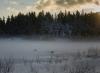
North Woods Naturalist: Snow and snow fog
-The North Shore has received significant snowfall over the past few weeks. WTIP's CJ Heithoff checks in with naturalist Chel Anderson to learn how this snow affects our wildlife. Chel also explains the rare wonder of snow fog in this edition of North Woods Naturalist.